
Aggregations
Definition
Aggregations allow you to make calculations on historical data to result into a single numerical value.
They consist in operations made on filtered data from your Marble database to extract a specific information, that you can then use in your formula.
Aggregation types
There are many available aggregation types on Marble:
- Average: calculates the average value of a numerical field in the data frame resulting from your filters
- Count: counts the total number of values in the data frame resulting from your filters
- Count distinct: counts the distinct number of values of a specific field in the data frame resulting from your filters
- Max: calculates the maximal value of a numerical field in the data frame resulting from your filters
- Min: calculates the minimal value of a numerical field in the data frame resulting from your filters
- Sum: calculates the sum of a numerical field in the data frame resulting from your filters
Building a variable
A aggregated operand is called a variable. Let's say we want to create a variable calculating the sum spent by the customer in card transactions in the last month.
A variable is composed of several elements:
- The variable name is indicative, it will help you understand quickly what the aggregation does when landing on the rule. It should be short but clear. In our example, we will name it "Sum card debits L1M"
- The function to be used: average, count, sum etc. Let's pick the
sumfor our example. - The object field is the field on which your are going to make the calculation, it will be
transactions.amountin our example. - The filters will let you narrow your database into the data frame you want to focus on. We will use it to focus on a) debit transactions, b) made by the current user, c) by card and d) in the last 6 months.
Filters can be divided in 3 parts:
- The 1st operand is necessarily a field from the table you selected in the object field.
- The 2nd operand is a field from the triggering object, or another function
- The operator will compare the two operands to result in a logical value
Here's what the variable looks like with our example:
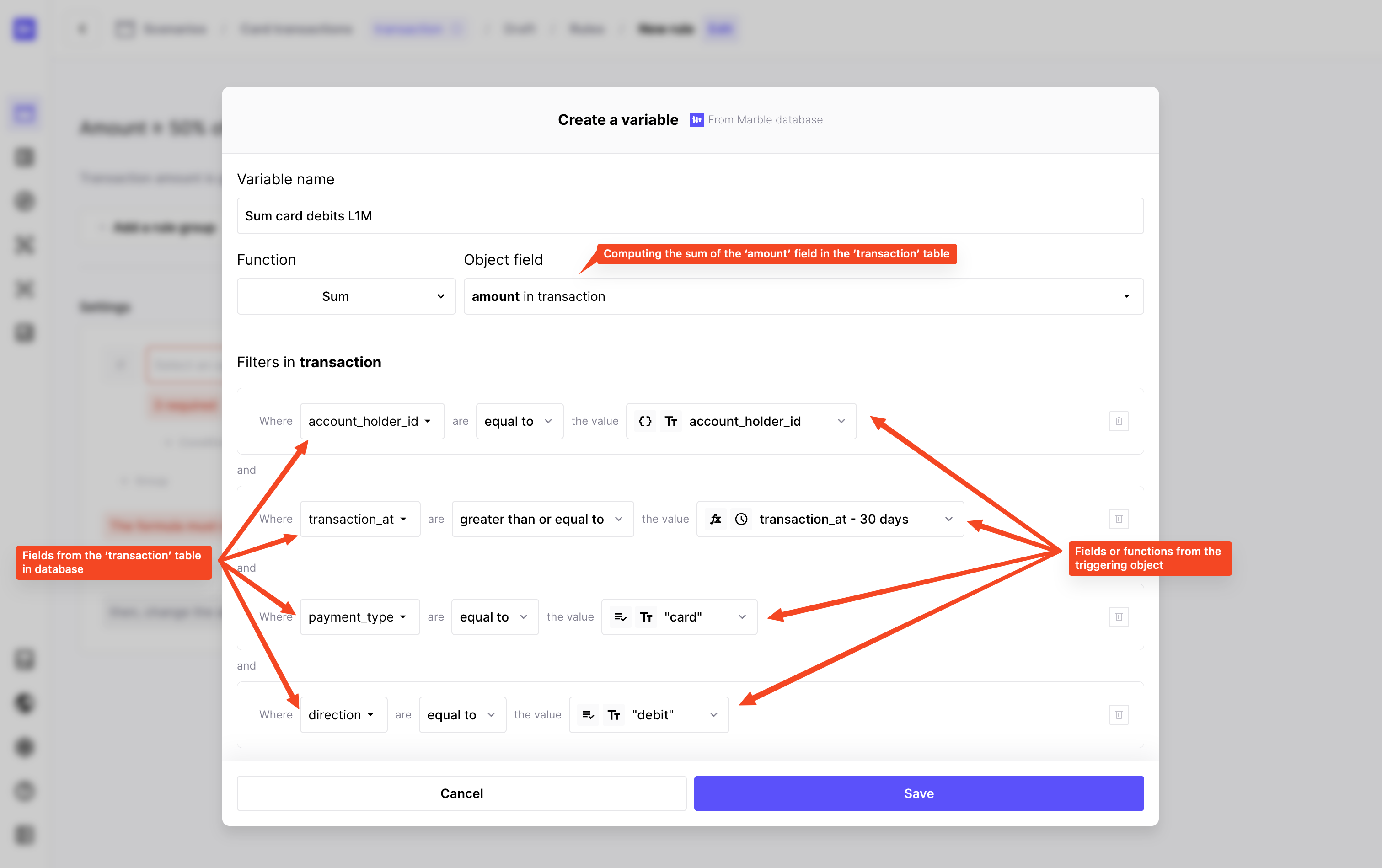
Variables apply filters on your database based on the triggering object
Note that you can (and probably will) combine aggregations and nesting. Here's a typical example of a condition checking if the transaction's amount is more than 10 times greater than the user's average transactions amounts in the last 2 months:

You can easily combine aggregations and nesting
Updated 9 months ago